
Then and Now
25 June, 2015
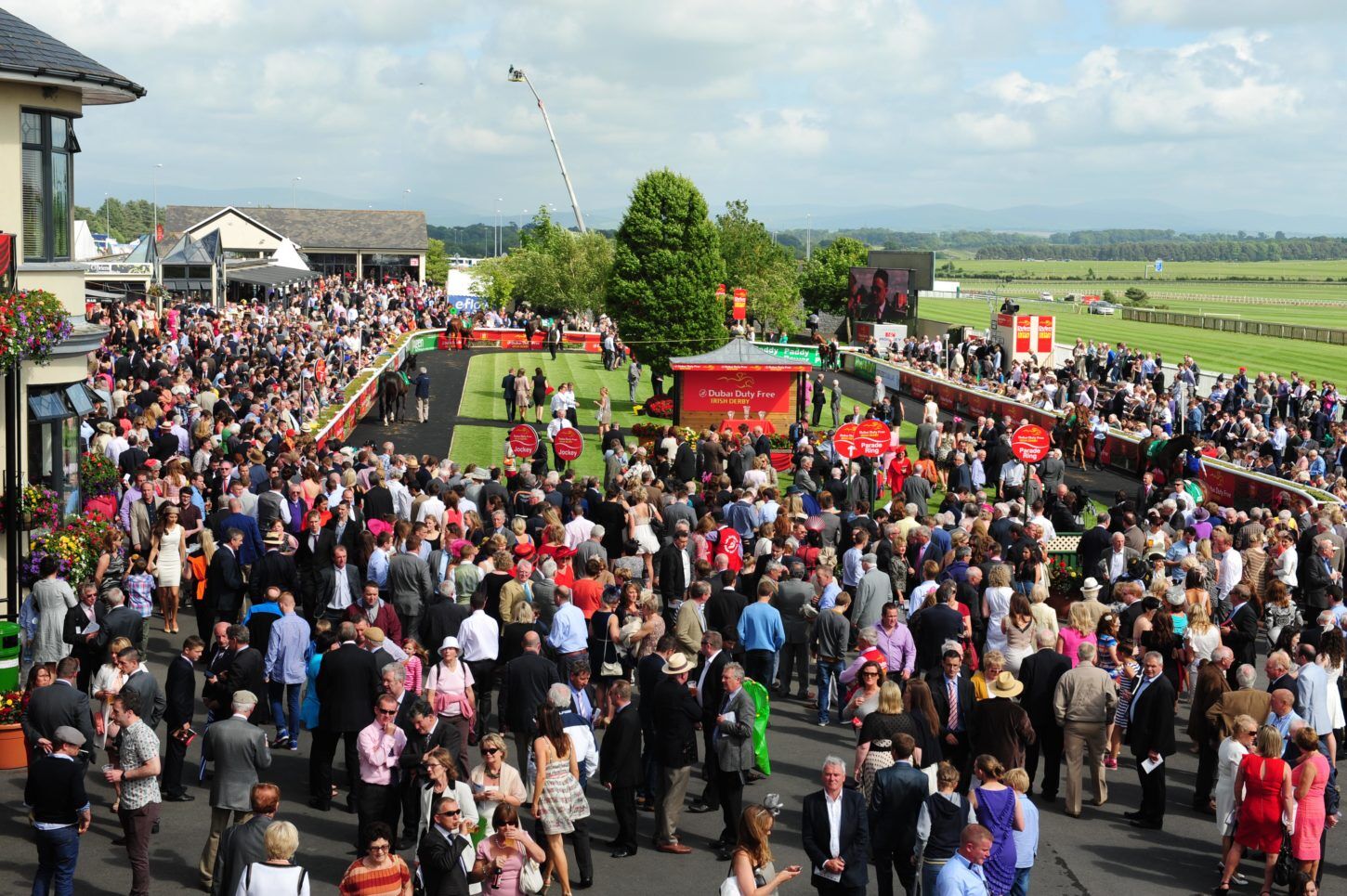
Enjoy the first and the most recent decades of Irish Derby performances ...
The Early Days ...
Half a century earlier in the 1860's the Turf Club had instituted the Irish Derby, not least to boost the appeal of Wednesday, the second session of what was then a four-day Curragh June meeting. Highlight of the Tuesday was the four-furlong Nursery Stakes. Likewise, Thursday's feature was the Waterford Testimonial Stakes, also for two-year-olds and run over the same four furlongs. This fixture then included three Queen's Plates, decided over two miles and three, seldom attracting more than a handful of runners.
Not, indeed, that the inaugural Irish Derby, run over one mile six furlongs, starting from the Red Post, attracted a big field. From thirty-eight original subscriptions only three faced the starter on 27 June 1866, two of those as yet un-named. Victory went to the only named contender, the English-trained Selim. Trained in Hednesford by Tom Cliff, Selim carried the all-white colours of inveterate English raider James Cockin. Selim was ridden by to his all the way success by Charles ‘Lucky' Maidment, twice champion jockey in Ireland and likewise in his native England.
Golden Plover represented the same team in 1867, with a similar result, winning in a canter. James Cockin enjoyed a splendid afternoon, successful in three of the four races down for decision. Dwindling numbers of subscriptions saw the value of the Irish Derby plummet from £400 to the winner in 1866 to a mere £115 two years later. Bee Quick went off 1-to-3 favourite to beat his solitary rival, Madeira. Those who did take the price were dismayed as Madeira forged clear in the hands of ‘Red' Denis Wynne to win by six lengths. ‘Mr Holland' concealed the identity of winning owner William Bourke, a successful Roscrea businessman, who had founded an extensive stud and training stables at Kilmartin House on the outskirts of that midland town.
James Cockin returned in search of further Irish Derby plunder (£280) in 1869, his filly Melody sent off marginally odds-on to defeat five opponents. She came very close. In a driving three-way finish the judge gave it to The Scout, by a head from Melody, with Rosette a neck back in third. Trained locally in French Furze by Laurence ‘Larry' Keegan, The Scout was ridden by William ‘Billy' Miller in the colours of John Johnstone of Skerries, land agent for the Holmpatrick family and a prominent racehorse owner of the time.
William Bourke, otherwise ‘Mr Holland', provided the favourite in 1870 when his Middleham-trained raider Lord Glasgow (as yet un-named) proved marginally more popular than his two rivals, Dubois and Billy Pitt. Once again that old adage - back the outsider in a field of three - proved correct. After a prolonged battle Billy Pitt held on to beat the favourite by a length with Dubois close on their heels. Although the outsider, Billy Pitt returned to a warm reception, reflecting the popularity of his owner Paddy Keary, one of Ireland's first bookmakers. The burly, jovial master of Herbertstown House, Naas, had a lengthy string in training with the Connollys of Curragh View. Paddy's insistence on settling in only one currency saw him dubbed ‘Bank of Ireland Keary'. Tom Connolly, more famously associated with Barcaldine, succeeded his father Pat, the first independent racehorse trainer in Ireland. Winning rider William Canavan, crowned Irish champion jockey that year, and his equally prominent brother David were sons of ‘Davy' Canavan, trainer of Valentine, the horse that gave his name to that formidable Aintree obstacle - Valentine's Brook.
The Decade & a Half Just Past ...
In the final year that Ireland's currency was in Irish Pounds (Punts) the Budweiser Irish Derby offered a record IR£510,865 to the winner. On all known form that looked odds-on to be Galileo, unbeaten winner of the Derby, in which he had beaten Golan, his closest pursuer by three and a half lengths. Exaltation - a surprise supplementary entry following his Gallinule Stakes success - represented John M Oxx, who hoped to collect valuable place money. The remaining nine runners were friendless in the market, with the exception of recent Italian Derby winner, Morshdi, an each-way prospect, supplemented at a cost of IR£90,000.
Morshdi's supporters were duly rewarded when their fancy finished a respectful four-length second to the imperious Galileo, with Golan a close third. Galileo thus compensated rider Michael Kinane for his disappointment when getting off Zagreb five years previously. Already eleven times Irish flat champion and the first Irish-based flat jockey to achieve international recognition, Michael J Kinane had finally added his name to the roll of honour of Ireland's great flat race, at his eighteenth attempt. Just how much this meant to the normally inscrutable rider became apparent through his ear-to-ear grin and repeated waving to the 30,000-strong attendance as he was led back to the winner's enclosure. When invited to hail Galileo as the best he had ridden, the 42-year-old jockey capitulated. “It is very rare that you ride a horse and feel in total control for the whole race but this is such a horse. Where others start to struggle, he still goes easily.The key is that he has such pace. It's a sign of a great horse that you can pick him out as the winner after just a furlong and that was the case today.â€
A fifth Irish Derby winner sired by Sadler's Wells, Galileo was out of Urban Sea, winner of the 1993 Prix de l'Arc de Triomphe. As it happened, Allegretta, Galileo's granddam was also the granddam of King's Best. David Tsui, Hong Kong-based owner of Urban Sea, shared the credit as breeder of Galileo with John Magnier, beneficial owner of Orpendale.
Galileo won the King George VI and Queen Elizabeth Stakes on his reappearance, beating Fantastic Light. They renewed rivalry in the Irish Champion Stakes, in which Fantastic Light triumphed by a head, thereby ending Galileo's six-race unbeaten record. Nor was Galileo to retire victorious, sixth to Tiznow in the Breeders' Cup Classic on unfamiliar dirt.
Not initially regarded as the long-sought successor at Coolmore to his legendary sire Sadler's Wells, Galileo was shuttled between the two hemispheres. The emergence from his very first Irish crop of champion two-year-old Teofilo, St Leger hero Sixties Icon and Breeders' Cup Turf winner Red Rocks, followed by Soldier Of Fortune and New Approach caused a rapid reappraisal, which saw Galileo go on to secure that crucial succession, copper-fastened for all time by the exploits of Galileo's unbeaten champion - Frankel.
Of Galileo's victims in that 2001 Budweiser Irish Derby, Golan went on to win the 2002 King George VI and Queen Elizabeth Stakes while Vinnie Roe racked up four consecutive Irish St Leger successes between 2001 and 2004.
In the absence of any worthwhile opposition Derby winner High Chaparral was long odds-on to provide the Ballydoyle team with a follow-up to Galileo in the first Budweiser Irish Derby run in the Euro era, which Ireland had entered at the start of 2002. In a market focused on betting ‘without the favourite' Sholokov, one of four Ballydoyle runners and the rank outsider at 200-to-1, attracted what appeared to be inspired support. A Group One winner in Italy as a two-year-old, Sholokov had run just once in 2002, unplaced behind stable companion Rock Of Gibraltar in the 2000 Guineas.
Under persistent rain the crowd of 27,134 watched as Sholokov and Balligarry set the gallop for the favourite. So well did that pair stick to their task it was not until inside the distance that Michael Kinane was able to assert on High Chaparral, pulling clear to beat Sholokov by three and a half lengths with Ballingarry holding Nysaean at bay by a head to provide Aidan O'Brien with a record Irish Derby one-two-three. High Chaparral thus provided part-owner Michael Tabor with a third irish Derby, following Desert king and Montjeu.Those who followed the money for Sholokov, ‘without the favourite,' were on a 40-to-1 ‘winner'. In addition to siring the first four to finish, Sadler's Wells also equalled Gallinule's longstanding record, having now been responsible for six Irish Derby winners - Old Vic, Salsabil, Dream Well, Montjeu, Galileo and High Chaparral.
Bred by Sean Coughlan, High Chaparral was out of Kasora, an unraced daughter of Darshaan and already the dam of three-time winner Oriental Ben. A 270,000-guinea yearling, High Chaparral had won two of his three juvenile starts, concluding with the Racing Post Trophy at Doncaster. As a three-year-old he had won the Ballysax Stakes, the Leopardstown Derby Trial, the Derby and now the Irish Derby. Third in the Prix de l'Arc de Triomphe, for which he started favourite, High Chaparral ended his 2002 campaign with a win in the Breeders' Cup Turf.
Kept in training as a four-year-old, High Chaparral did not reappear until August when he won the Royal Whip at the Curragh, following up with the Irish Champion Stakes at Leopardstown. Once again beaten favourite in the Prix de l'Arc de Triomphe, High Chaparral signed off on a winning note when becoming the first dual winner of the Breeders' Cup Turf, albeit dividing the spoils with Johar. As a stallion High Chaparral shuttled between Coolmore, New Zealand and Australia, where he sired a champion in So You Think.
Something of a ‘slow burn' as a stallion in the northern hemisphere, High Chaparral came to the fore in 2014 as sire of such as Toronado, High Jinx, Lucky Lion and Free Eagle, only to succumb to fatal internal injuries in January 2015, his fee for the coming season advertised as €30,000.
In his bid to complete a Budweiser Irish Derby hat trick, Aidan O'Brien saddled six of the nine-strong field. Stable jockey Michael Kinane plumped for The Great Gatsby, second at Epsom, where Alamshar had finished just a short head back in third. In the absence of Epsom winner Kris Kin and indeed any English-trained runner for the first time since 1976, Dalakhani, unbeaten in all six starts including the Prix du Jockey-Club, became the odds-on favourite to provide owner-breeder HH Aga Khan IV with a record-equalling fifth Irish Derby. Only after heavy rain had changed the Curragh going from ‘good to firm' to ‘yielding' did trainer John M Oxx confirm that Alamshar would carry HH Aga Khan's second colours - ‘Green, brown hoops and cap'.
As a tableau vivant the 2003 Budweiser Irish Derby was a delight to witness. But for visiting rider Christophe Soumillon aboard Dalakhani it proved a nihtmare. The Ballydoyle pacemakers High Country and Handel set a blistering pace, clearly unsustainable, at least to one familiar with the Curragh, like Johnny Murtagh. Having sat third behind the ‘rabbits', Soumillon found himself in front far too soon when the leaders compounded. He now became the prey, stalked by the wily Murtagh, poised to pounce. Dalakhani tried his best to fend off Alamshar's late challenge, which had the crowd in uproar, but to no avail. At the line Alamshar was home with half a length to spare. Winning trainer John Oxx summarised the result. “He was possibly a bit fortunate to win as Dalakhani was ridden a bit too positively and his rider's tactics played into our hands.â€
HH Aga Khan IV insisted that he was perfectly content with the outcome, which had seen him equal his grandfather's record of five Irish Derby triumphs. Moreover, he had actually outdone his grandfather in having not just owned but also bred all five. By the American import Key Of Luck, Alamshar was out of Alaiyda, a daughter of Shahrastani, the Aga's dual Derby winner of 1986. Moreover, Alaiyda happened to be a daughter of Aliysa, the disqualified winner of the Oaks, which decision had prompted the Aga Khan to withdraw his horses from training in Britain.
Events were to prove Dalakhani an unlucky loser of his unbeaten record in the Irish Derby. On his two subsequent appearances he won both the Prix Neil and then the Prix de l'Arc de Triomphe, rated champion three-year-old in Europe. As a stallion Dalakhani went on to make his name by siring such as Conduit, Chinese White, Duncan, Moonstone and Reliable Man, winner of the Prix du Jockey-Club. By contrast, Alamshar, having won the King George VI and Queen Elizabeth Stakes, flopped in both the Irish Champion Stakes and the Champion Stakes at Newmarket. His subsequently disappointing stud career comprised two spells in Japan interspersed by a stint in the Irish National Stud.
The rout of the Ballydoyle battalion in the 2003 Irish Derby was redressed in part by Brian Boru going on to St Leger triumph, while Powerscourt collected the Great Voltigeur Stakes - at the immediate expense of Brian Boru - en route to a Tattersalls Gold Cup and then an Arlington Million, earning his place at stud in Kentucky.
For the first time in its history the 2004 Irish Derby - sponsored by Budweiser since 1986 - attracted all first four finishers at Epsom. There North Light had led home Rule Of Law, Let The Lion Roar and Percussionist, all of them trained in England. Determined to try conclusions once more, Sheikh Mohammed's Godolphin operation willingly supplemented Rule Of Law at a cost of €95,000. A poor season by Aidan O'Brien's exalted standards ensured that his quintet of hopefuls could be backed at prices ranging from Cobra at 25-to-1 to Tycoon at 150-to-1, whereas North Light remained firmly odds-on to confirm Epsom form.
As so often, the key lay in the state of the going, ‘good to firm', for the first time in ten years. Visibly ill at ease on the lively terrain, North Light confirmed the Epsom form, but could not peg back Grey Swallow, going down by half a length at the line. While few might have backed this 10-to-1 winner, he and Pat Smullen returned to a vociferous welcome, most of it directed at the grey colt's stooped breeder and joint-owner, Marguerite Weld, whose son Dermot had now trained his second Budweiser Irish Derby winner following Zagreb. Neither Rochelle ‘Shelly' Quinn, the New Yorker in whose colours Grey Swallow ran, nor minority shareholder Terry Ramsden had been able to attend.
Grey like his sire, Grey Swallow was by Daylami out of Style Of Life, a winner and already dam of six winners. Having gone through the ring as a yearling for 150,000 guineas, Grey Swallow won his maiden at his trainer's favoured Galway by ten lengths. In following up in the Killavullen Stakes at Leopardstown Grey Swallow was rated the best two-year-old in Ireland. Beaten by Bago in the Prix de l'Arc de Triomphe, Grey Swallow gained his revenge at the Curragh as a four-year-old. Subsequently sold to race in America and latterly in Australia, Grey Swallow eventually retired to stud Down Under. Whereas North Light failed to win again, Rule Of Law came good when winning both the Great Voltigeur and St Leger.
Pat Smullen, native of Rhode, County Offaly, began his admirably consistent career apprenticed to local trainer TF ‘Tom' Lacy, who provided him with his first winner, Vicosa, at Dundalk. Champion apprentice in 1995 and 1996, Pat succeeded Michael Kinane as stable jockey to Dermot Weld in 1999, a role that would see him crowned Irish champion flat jockey on the first of numerous occasions in 2000. By the time he had ridden his first domestic century of winners in one season in 2014, Pat Smullen had achieved international recognition as a rider who won far more races against the odds than he ever lost.
Epsom form was represented by Walk In The Park, Fracas and Gypsy King, respectively second fourth and fifth behind Motivator. Hurricane Run, beaten just a neck by Shamardal in the Prix du Jockey-Club - reduced now to ten and a half furlongs - was accompanied from Chantilly by Walk In The Park, each seeking to go one better in the Budweiser Irish Derby. Hurricane Run's position at the head of the betting market owed not a little to his recent purchase by John Magnier as a prospective addition to the Coolmore stallion strength, being from the first crop of the instantly successful Montjeu. While the colt was leased back to his former owner, Gestut Ammerland, for the Irish Derby, it was on condition that the current Balydoyle stable jockey, Kieren Fallon, should replace Christophe Soumillon.
In a market dominated by the French-trained pair, only Fracas, a first Irish Derby runner for trainer David Wachman, was backed to keep the €745,100 winner's prize at home. As Brahminy Kite made the early running, watched by an attendance of 31,144, Gypsy King stumbled, unseating JA ‘Shamie'Heffernan. The Ballydoyle runner was found to have broken a shoulder, necessitating his destruction. On turning for home Scorpion hit the front, looking likely to spring a surprise, until Fallon galvanised a late run from the favourite, enough to see him home by half a length from Scorpion with Shalapour four lengths further adrift in third. Walk In The Park's dismal performance - he finished last - was subsequently attributed to a respiratory tract infection.
Bred at his Gestut Ammerland in Munich, Bavaria, by Munich lawyer Dietrich von Boetticher, Hurricane Fly was out of Hold On, a winning daughter of German Derby winner and six times German champion sire Sumuru. Trained by Andre Fabre, previously successful with Winged Love in 1995, Hurricane Run had won his solitary start as a two-year-old, his only subsequent defeat coming in the Prix du Jockey-Club. Put by for an autumn campaign, Hurricane Run reappeared to win his Arc preparatory race and then the Prix de l'Arc de Triomphe itself. Kept in training as a four-year-old, Hurricane Run won twice more from seven starts, successful in the Tattersalls Gold Cup and in the King George VI and Queen Elizabeth Stakes, before joining his sire in Coolmore.
Kieren Francis Fallon, a native of Crusheen, County Clare, served his time with Kevin Prendergast, moving to the north of England to ride for Jimmy FitzGerald and Lynda Ramsden. A surprise appointment as stable jockey to Henry Cecil, he went on to become English champion jockey from 1997 to 1999, a sequence that might have extended but for a career-threatening fall at Royal Ascot in 2000. Subsequently associated with Michael Stoute and latterly with Aidan O'Brien, Kieren Fallon had ridden the winner of the Derby on Oath (1999), Kris Kin (2003) and North Light (2004) before adding an Irish Derby to his glittering portfolio. He acknowledged its significance. “It means a lot to win this race, especially after thinking I'd win it on North Light last year only to finish second. For years I've dreamed about winning this race, ever since I was an apprentice with Kevin Prendergast. It means everything.â€
Winning trainer Andre Fabre observed: “It's a Derby and you never win them easily.†Kieren Fallon, bringing his Irish Derby Festival weekend tally to eight, went further. “It couldn't have been a much better weekend. Hurricane Run is a horse you really need to know and I hadn't sat on him. We lost a lot of ground going round the outside and he was still good enough to win. The winning colours have been lucky for me because I rode my first ever Group One winner in them on Borgia in Germany.†The merit of Hurricane Run's Irish Derby was repeatedly endorsed by his immediate victim. Scorpion went on to win the St Leger, Coronation Cup and Grand Prix de Paris, besides chasing home his magnificent stable companion Yeats in an Irish St Leger, subsequently retiring to Castle Hyde as a dual-purpose sire.
No fewer than four supplementary entries at €100,000 each not only created a thirteen-strong field, but boosted the winner's prize for the 2006 Budweiser Irish Derby to a record €847,500. The supplemented quartet represented English, French and Italian classic form. Dragon Dancer, beaten a short head at Epsom by Sir Percy, was bidding to become the first maiden to succeed in an Irish Derby since Sindon in 1958. Darsi, winner of the abbreviated Prix du Jockey-Club was likewise supplemented by his owner-breeder HH Aga Khan in the belief that the traditional Derby distance would play to his strengths. European classic form was further boosted by the late inclusion of Gentlewave, recently successful in the Italian Derby for trainer Andre Fabre.
Among the home team Dylan Thomas, beaten a short head and a head at Epsom, was entitled to be prominent and as such started favourite to bring the great prize back to Ballydoyle. Darsi and Gentlewave were next in demand, the rest freely available at all prices up to Monsieur Henri, 400-to-1 to succeed for local trainer John C Hayden. Dragon Dance got a flier from stalls, Daryll Holland powerless to restrain his headstrong mount. His task was eased when Heliostatic then took charge with Kevin Manning, leading his field into the straight. There Gentlewave took over, until mown down by Dylan Thomas, three and a half length his conqueror at the finish, with Best Alibi and Dragon Dancer completing the placings. Kieren Fallon threw his whip and goggles to the crowd in jubilation, describing Dylan Thomas as “electricâ€.
Bred by Tower Bloodstock, a Coolmore satellite, Dylan Thomas became a second Irish Derby winner for his sire Danehill, previously responsible for Desert King, successful in 1997. Lagrion, Dylan Thomas' dam, had already produced Queen's Logic, rated top two-year-old filly in Europe in 2001 and would subsequently give birth to Homecoming Queen, runaway winner of the 1000 Guineas in 2012. Dylan Thomas went on to win the Irish Champion Stakes, beating Ouija Board. However, failures in Britain and America over two campaigns gave rise to supposition that the 2006 Irish Derby winner was a bad traveller, such rumours vehemently denied by his trainer.
Kept in training as a four-year-old, Dylan Thomas won the Alleged Stakes on the Curragh before posting his first overseas victory in the Prix Ganay at Longchamp, vindicating Aidan O'Brien. Thereafter an up-and-down campaign yielded wins in the King George VI and Queen Elizabeth Stakes, a second Irish Champion Stakes and ultimately the 2007 Prix de l'Arc de Triomphe, albeit only after surviving an interminable stewards' enquiry. Further forays in the Breeders' Cup Turf and the Hong Kong Vase at Sha Tin saw Dylan Thomas retired to Coolmore as the winner of half of his twenty starts, from seven to twelve furlongs. Subsequently shuttled between Coolmore and Australia, Dylan Thomas has sired numerous winners, though none as yet in the same league as himself.
News that the 2007 Irish Derby was to be the twenty-second and final running sponsored by Anheuser-Busch was greeted with widespread regret, bringing to an end, as it did, the longest-running sponsorship of any classic race in these islands. Moreover, the announcement coincided with the initial stages of an ambitious development plan designed to elevate the ‘Home of the Classics' to its rightful place among the foremost racecourse complexes worldwide.
Eagle Mountain, a fast-finishing second to Authorized at Epsom, went off favourite to provide jockey Kieren Fallon with a record Irish Derby hat trick despite concerns about the Ballydoyle colt's ability to handle underfoot conditions officially classified as ‘soft to heavy'. Those misgivings were proved correct, Eagle Mountain finishing only third, nine lengths and a short head behind his stable companions Soldier Of Fortune and Alexander Of Hales (USA). Aidan O'Brien thereby repeated his one-two-three previously achieved in 2002 when High Chaparral led home Sholokov and Ballingarry.
Aidan O'Brien once again hinted at his uncanny insight into the horses in his care. “If his attitude hadn't changed so much since his last race, you could put today down to the ground. But his whole demeanour has changed for his run at Epsom. Before that he was working well, and everything was fine physically with him, but he was working without a smile on his face. Since Epsom he has been coming into the barn every morning with a grin.â€
A record sixth Irish Derby winner for owners Sue Magnier and John Tabor, Soldier Of Fortune was also owned in part by Derrick Smith, whose colours were soon to become equally familiar on Ballydoyle runners. Bred by Jim Bolger, Soldier Of Fortune was the first Irish Derby winner sired by Galileo, himself successful in the race in 2001. Affianced, the dam, likewise had Irish Derby connections, being a half-sister to Sholokhov, runner-up to High Chaparral in the 2002 Irish Derby. Purchased privately, Soldier Of Fortune had won the Prix Noailles at Longchamp and the Chester Vase, finishing fifth at Epsom prior to his Curragh triumph. Subsequently successful in the Prix Neil, he remained in training as a four-year-old, making a winning reappearance in the Coronation Cup at Epsom. Soldier Of Fortune was retired to stand in Normandy.
Winning rider JA ‘Shamie' Heffernan, a graduate of RACE like Johnny Murtagh, could also be said to be a graduate of Jim Bolger's celebrated academy in Coolcullen, where he became Irish champion apprentice in 1994. Throwing in his lot with Aidan O'Brien - another Coolcullen graduate - Shamie Heffernan gladly accepted the role of stable number two when Aidan took charge at Ballydoyle in 1996. In that capacity he understudied Christy Roche, Michael Kinane, Jamie Spencer, Kieren Fallon and Johnny Murtagh. His big-race record provides ample justification for Shamie Heffernan's contention that being second jockey to Aidan O'Brien is more rewarding than number one in most other stables.
As had been widely predicted, sponsorship for the Irish Derby in the wake of Anheuser Busch's withdrawal came from the Middle East. Dubai Duty Free, one of the largest airport retailers in the world, stepped seamlessly into the breach, ensuring that the Dubai Duty Free Irish Derby retained its status as the major European classic that it had become from 1962. Galwegian Colm McLoughlin, DDF chief executive, committed to a three-year association, while making it abundantly clear that DDF should not be regarded as a charitable institution. To an extent his involvement was seen as a form of salvation at a time when grandiose plans for the Curragh's transformation lay in tatters. Overnight economic recession, with its attendant European Central Bank bail out overseen by The Troika, had become Ireland's lot.
More immediately, the outcome of the inaugural Dubai Duty Free Irish Derby hinged on the participation of Epsom winner New Approach. A niggling foot bruise created such uncertainty in the Coolcullen camp that Princess Haya of Jordan played safe by supplementing Upton Grey as pacemaker for her Derby winner at a cost of €150,000.
When Jim Bolger finally announced New Approach a non-runner on the morning of the race it was decided to let Upton Grey take his chance, there being prize money to the first ten finishers out of eleven confirmed starters. In New Approach's regrettable absence the €843,000 first prize appeared at the mercy of English challenger Tartan Bearer, just caught on the post at Epsom, with Casual Conquest in third and a further five Curragh hopefuls further down that Epsom field. Tartan Bearer duly went off even money favourite with only Casual Conquest backed to reverse their Epsom running.
Casual Conquest proceeded to do just that, by a short head, albeit only after the stewards had demoted the errant Alexandra Volta from third to fourth for causing mayhem in the closing stages. Meanwhile, ‘Shamie' Heffernan had galvanised a late run from Frozen Fire sufficient to see him two lengths clear at the line, ahead of a blanket finish for the minor placings reminiscent of Santa Claus versus the rest in 1964.
Having revised the placings to the satisfaction of some, if by no means all, the stewards queried Aidan O'Brien apropos Frozen Fire's apparent improvement in form. When his explanation - failure to act on the Epsom course and lack of pace at crucial stages - was accepted Aidan O'Brien could reflect that he had now equalled Vincent O'Brien's record Irish Derby haul - six. But more remarkable was Aidan's Irish classic sequence, now standing at six but destined to extend to nine in a row.
Frozen Fire, by Montjeu out of Flamingo Sea, was bred in Germany by Jurgen and Wolfgang Hoyer, raised at Michael Andree's Gestut Romerhof and bought as a yearling for €250,000 by the Coolmore consortium. Carrying the colours of Michael Tabor, Frozen Fire made a winning debut at Gowran Park, only to disappoint in the Racing Post Trophy. Reappearing in the Dante Stakes at York, Frozen Fire ran Tartan Bearer to a head before failing to act on Epsom's contours. Unplaced favourite in the St Leger, Frozen Fire failed to win as a four-year-old. He was eventually retired to Bernard and Ann Stack's Coolagowan Stud, Fermoy, County Cork in 2012, having won just two of his thirteen starts.
The Turf Club's decision, announced in November 2008, that redevelopment plans for the Curragh had been put on indefinite hold came as a relief to many fearful of the implications of closing the Curragh for a year. More immediately, the prospect of Sea The Stars, Fame And Glory and Masterofthehorse, first, second and third in an all-Irish Derby finish, renewing rivalry at the Curragh promised the most enthralling Irish Derby for some years.
Unfortunately, the course manager's watering programme was sabotaged by the clerk of the weather, leading to the withdrawal of emergent champion Sea The Stars. In his widely lamented absence Fame And Glory became odds-on to confirm Epsom placings with stable companion Masterofthehorse, bookmakers going 10-to-1 bar two on a field of eleven runners, all of them trained in Ireland, six in Ballydoyle. The Ballydoyle pacemakers played their part, setting the race up for Fame And Glory, the impressive five-length winner from stable companion Golden Sword. The winner carried the purple and white livery of Derrick Smith, with whom Sue Magnier and Michael Tabor divided the ownership of the majority of the Ballydoyle inmates, their colours allocated by lot for each successive annual intake.
A third Irish Derby winner sired by Montjeu, following Hurricane Run and Frozen Fire, Fame And Fortune was out of Gryada and bred by Kirsten Rausing and Ptarmigan Bloodstock. Unbeaten in his first four races and second to Sea The Stars at Epsom, Fame And Glory again gave best to Sea The Stars in the Irish Champion Stakes at Leopardstown, unplaced for the first time in his career when down the field behind Sea The Stars in the Prix de l'Arc de Triomphe. Kept in training for a third campaign, Fame And Glory rewarded that decision with four further successes, notably the Tattersalls Gold cup at the Curragh and the Coronation Cup at Epsom.
In March 2011 came the news that Dr Jim Hay and his wife Fitri had purchased a majority interest in the 2009 Irish Derby winner, with the result that Fame And Glory remained in training as a five-year-old, a rare occurrence for a Derby winner in the modern era. That adventurous policy received its just reward when Fame And Glory won both his starts in Ireland en route to justifying favouritism in the Ascot Gold Cup. In doing so Fame And Glory became the first Irish Derby winner to complete that double. Moreover, the last to complete the Derby - Ascot Gold Cup double had been Ocean Swell during World War Two. Fame And Glory signed off his 2011 campaign on a winning note in the Qipco British Champions Long Distance Cup at Ascot in October. Attempts to extend the horse's career into a fifth season brought scant reward.
Top rated older horse in Ireland in 2010 and likewise in England and Ireland in 2011, Fame And Glory retired to stand at Grange Stud, the ancestral Magnier home outside Fermoy. Winner of 14 races from one mile to two and a half miles and prize money in excess of £2m, Fame And Fortune was a high-class, durable and versatile performer, simply unfortunate to have been born in the same year as Sea The Stars.
Unable to call upon his stable star, St Nicholas Abbey, to extend his Irish Derby sequence in 2010, Aidan O'Brien nonetheless saddled four fancied contenders, together with pacemaker Bright Horizon. Of the Ballydoyle quintet At First Sight, Jan Vermeer and Midas Touch had finished second, fourth and fifth respectively to Workforce at Epsom. Nonetheless, stable jockey Johnny Murtagh was declared to ride Cape Blanco, despite that colt losing his unbeaten record when only tenth to Lope De Vega in the Prix du Jockey-Club. That was enough to ensure Cape Blanco starting shortest of the O'Brien team, marginally preferred in the market by Middleham raider Monterosso, recent winner of the King Edward VII Stakes at Royal Ascot and supplemented at a cost of €125,000.
Johnny Murtagh's day got off to an alarming start, unseated when his mount, Petronius Maximus crashed through the plastic running rail when disputing the lead a furlong out. Luckily, Johnny escaped shaken but unharmed. Nevertheless, it was enough to see Jan Vermeer become the Ballydoyle contender in most demand, with Cape Blanco now easing in the market. From a 5.10pm start Bright Horizon set a searching gallop until headed into the straight by Midas Touch. Hard as he tried, Midas Touch was worn down by Cape Blanco, with Jan Vermeer making this a third Irish Derby one-two-three for Aidan O'Brien. It also meant that Aidan O'Brien had now won five consecutive renewals, a record for the Irish Derby and a classic sequence now poised to equal Robert Robson's six successive 1000 Guineas wins, achieved between 1818 and 1823.
Cape Blanco, a chestnut son of Galileo, was bred by Jack Ronan and Des Vere Hunt out of the winning sprinter Laurel Delight. Unbeaten in three starts as a two-year-old, Cape Blanco had reappeared to beat Workforce in the Dante Stakes at York Whereas Workforce had gone on to Epsom glory, Cape Blanco had flopped at Chantilly. A somewhat remote second to Harbinger in the King George VI and Queen Elizabeth Stakes, Cape Blanco bounced back to form in the Irish Champion Stakes, making every yard under ‘Shamie' Heffernan to score from stable companion Rip Van Winkle, the choice of stable jockey Johnny Murtagh.
Over the winter Jim and Fitri Hay purchased what was described as a “significant interest†in Cape Blanco, paying dividends in the latter part of the 2011 campaign when Cape Blanco won the Man o' War Stakes at Belmont Park, the Arlington Million and then the Joe Hirsch Turf Classic back in Belmont Park. Unfortunately, a fractured knee, incurred in running, brought to a close a career that had yielded nine wins from fifteen starts, all but one of those at Group and Graded level, from seven furlongs to a mile and a half. Cape Blanco was retired to stand at the Ashford Stud, Kentucky, an arm of the Coolmore empire. Of Cape Blanco's Curragh victims Monterosso, fourth on that occasion, went on to triumph in the 2012 Dubai World Cup.
Strictly on Epsom form there was little to prevent Aidan O'Brien carrying off yet another Irish Derby, thereby equalling Robert Robson's classic sequence which had stood for almost two centuries. In the absence of Pour Moi, last-stride Derby winner, Treasure Beach, the short head runner-up and Memphis Tennessee, fourth home, seemed to have it between them. However, trainer Michael Stoute's confidence that Carlton House would improve on his luckless third in the Derby to make it a first success at the first time of asking for a royal runner in an Irish Derby. His enthusiasm proved sufficiently infectious to see Carlton House oust Treasure Beach from favouritism.
In what was becoming a familiar pattern Memphis Tennessee made it from his more fancied stable companions Seville and Treasure Beach. Taking it up in the straight, Seville fought off challenges from Native Khan and Carlton House, only to give best after a prolonged tussle with Treasure Beach. With Memphis Tennessee staying on again late to pip Carlton House by a neck for third place, Aidan O'Brien had once again completed an Irish Derby clean sweep, in addition to equalling Robert Robson's classic sequence.
Bred by Brian and Jane Hammond at their Ashley House Stud in Devon, Treasure Beach was by Galileo out of Honorine, a winning daughter of 2000 Guineas winner Mark Of Esteem. Purchased as a foal for 180,000 guineas by Timmy Hyde's Camas Park Stud, Treasure Beach had won twice as a two-year-old, reappearing to win the Chester Vase prior to his short head defeat at Epsom. Only fourth in the Grand Prix de Paris, Treasure Beach went on to win the Arlington Million. Kept in training as a four-year-old in which Mrs Fitri Hay acquired an interest, Treasure Beach failed to add to his score.
Winning rider Colm O'Donoghue had served his apprenticeship with Aidan O'Brien, remaining on as a valued member of the Ballydoyle team. Three times second in the Irish Derby, Colm had received his due reward when coming good, “under real pressure†in his trainer's words, on Treasure Beach.
Winning rider Colm O'Donoghue had served his apprenticeship with Aidan O'Brien, remaining on as a valued member of the Ballydoyle team. Three times second in the Irish Derby, Colm had received his due reward when coming good, “under real pressure†in his trainer's words, on Treasure Beach.
Amid continuing economic doom and gloom came the welcome news that Dubai Duty Free had signed up for a further three years' sponsorship, to include the 150th Irish Derby in 2015. On the downside, the demands of terrestrial television coverage necessitated Irish Derby day being reprogrammed as a ‘twilight' fixture, with the DDF Irish Derby the final event on an eight-race card, timed for 7.40pm, followed by a Ronan Keating concert.
None of this mattered, provided Camelot, unbeaten winner of the 2000 Guineas and Derby, showed up. Ten years had elapsed since High Chaparral had attempted the Derby double, successfully as it happened. The 2012 renewal needed the superstar that Camelot stood to become. His participation was increasingly threatened by incessant rain, which obliged the Curragh to classify the going on Derby day as ‘Soft to Heavy'.
Aidan O'Brien, Camelot's trainer, exercised characteristic restraint in describing underfoot conditions as “not idealâ€. Speculation apropos Camelot's participation was only set at rest following the announcement that the dual classic winner and odds-on favourite was a definite runner, but his stable companion Imperial Monarch had been withdrawn. As the latter was known to relish soft ground, this was widely interpreted as a precaution on Aidan O'Brien's part, lest Imperial Monarch prove the better on the day.
Imperial Monarch's withdrawal ensured Camelot starting long odds-on under regular partner Joseph O'Brien, the trainer's son, who had earned his spurs as the new Ballydoyle stable jockey. In a field of just five, all home-trained, the only conceivable danger appeared to be Born To Sea, a half-brother to Sea The Stars, untried over the Derby distance and blinkered for the first time. So it transpired, Camelot overcoming ground he clearly detested to get home by two lengths from Born To Sea with Light Heavy a further nine lengths in arrears. The Coolmore consortium received deserved acclaim for risking their potential Triple Crown winner in such dire conditions.
Joseph O'Brien paid tribute to his mount. “I was very worried on the turn-in. It's very heavy ground. They were barely getting through it. But he showed his class and his heart.†In doing as he did Camelot became Aidan O'Brien's seventh consecutive Irish Derby winner and his tenth to date. Moreover, Aidan O'Brien had now surpassed Robert Robson's two-hundred-year-old classic record, in addition to becoming his twenty-eighth Irish classic success, beating Vincent O'Brien's record.
A bay son of Montjeu out of the Kingmambo mare Tarfah, Camelot had been bred at the Highclere Stud, Newbury, by Sheikh Abdulla bin Isa al-Khalifa and purchased as a yearling for 525,000 guineas by DL ‘Demi' O'Byrne MRCVS on behalf of the Coolmore consortium. Preceded by a glowing home reputation, Camelot had made an odds-on winning debut at Leopardstown as a prelude to taking the Racing Post Trophy at Doncaster. Impressive when winning the 2000 Guineas on his reappearance, Camelot had overcome Epsom's testing contours to win the Derby and had now become the sixteenth to complete the Epsom-Curragh Derby double.
Queried about the possibility of Camelot attempting to become the first Triple Crown winner since the mighty Nijinsky back in 1970, John Magnier surprised many by his response. “We're so old these things mean more now. Had you asked me thirty years ago I might have turned away.†In fact, the decision to go for the Triple Crown had been taken well before Camelot was risked to restore the status of the Irish Derby.
Having won his seventh successive Irish Derby and his tenth in all, Aidan O'Brien revealed his motivation. “The Triple Crown is always the dream. This horse has passed all the tests. We have a statue of Nijinsky at the gate in Ballydoyle. He looks at us every day going in and out. We have always dreamed that we would have another one to put on the other side of the gate.â€
Odds-on to emulate Nijinsky, Camelot found one too good for him in the Godolphin outsider, Encke, in the process thwarting Aidan O'Brien's attempted clean sweep of the 2012 English classics. Camelot's failure to complete his Triple Crown was widely attributed at the time to his Irish Derby ordeal. Subsequent disclosures would reveal that Encke's dramatic improvement in form had a more sinister basis. An unsuccessful tilt at Prix de l'Arc de Triomphe compensation was quickly followed by a bout of colic. Happily, Camelot recovered to make a winning 2013 debut in the Mooresbridge Stakes at the Curragh. However, his failure to cope with Al Kazeen in either the Tattersalls Gold Cup or at Ascot, together with the untimely demise of his sire Montjeu in March 2012, saw Camelot retired to take his sire's place in Coolmore.
Another ‘twilight' Dubai Duty Free Irish Derby seemed destined to fall to Ballydoyle, represented by Epsom winner Ruler Of The World and Festive Cheer. Ridden by Joseph O'Brien, Ruler Of The World started marginally odds-on to complete his Derby double, with only the supplemented English raider and Epsom runner-up Libertarian backed to beat him. In the event neither ran up to form as Trading Leather stormed home to beat Galileo Rock and Festive Cheer by one and three-quarters of a length and the same.
Bred by his trainer Jim Bolger, running in his wife Jackie's colours and ridden by their son-in-law and longstanding stable jockey Kevin Manning, Trading Leather posted the second-fastest time for the race since St Jovite, Jim Bolger's previous winner back in 1992.
The trainer described it as “probably my best day in racing. It probably doesn't get any better than this.†Behind that statement lay a ‘back story' whereby Jim Bolger's conviction that Galileo had all the credentials to become a champion sire had seen him repeatedly send his best mares to the Coolmore freshman. Thus had he bred and raced Teofilo, undefeated juvenile champion and now the sire of an Irish Derby winner in Trading Leather.
During the winter Sheikh Mohammed acquired a majority share in Trading Leather, content to leave the colt with Jim Bolger for his four-year-old campaign. In the course of the 2014 season Trading Leather competed with honour at the highest level, with the end-of-season Japan Cup as his ultimate objective. Sadly, that ended in disaster. Trading Leather sustained such injuries in running that he could not be saved for stud.
Long before he made his racecourse debut Australia was being touted as the best Aidan O'Brien had ever put through his hands. On his last appearance Australia had become the first animal by a Derby winner, Galileo, out of an Oaks heroine, Ouija Board, to win the Derby since its inception in 1780. Only Kingston Hill, second at Epsom, posed any serious threat to Australia completing his Derby double. Once drying ground caused Kingston Hill's withdrawal, Australia became long odds-on to beat just four rivals, two of those from his own stable. Those who took the price never had any cause for concern. Once Joseph O'Brien loosed an inch of rein the chestnut cruised clear to lead home another Ballydoyle one-two-three, beating Kingfisher and Orchestra.
Part-owner John Magnier - inducted into the Curragh's Hall of Fame at this Irish Derby renewal - reflected on his lengthy association with the Irish Derby. “It is a pity that the French Derby has been reduced from a mile and a half to ten furlongs, because it used to be that the French Derby winner and the Epsom Derby winner would come on to the Curragh and it would be winner takes all. But there is no doubt, I get excited by a horse like this. Watching Joseph sitting up on him there, it was like watching Lester in the old days on some of those real racehorses. Aidan told everyone what he thought about the horse from early and now he has gone and done it.â€
Australia continued his winning ways in the Juddmonte International Stakes at York from Oaks and King George VI and Queen Elizabeth Stakes heroine Tagrooda with Prix du Jockey-Club winner The Grey Gatsby back in third. However, the Qipco Irish Champion Stakes at Leopardstown provided the upset of the season when The Grey Gatsby out-battled Australia to reverse that York form. Sometime later it was announced that Australia was to stand alongside his sire Galileo in Coolmore for the 2015 covering season, his fee set at €50,000.
Back